

NIO is a Chinese electric vehicle maker founded in 2014 and headquartered in Shanghai — a relatively young but fast-moving company in the EV ecosystem. The company is publicly traded in the U.S. as an American Depositary Receipt (ADR) under the ticker NYSE: NIO.
What NIO makes and sells
At its core, NIO designs and sells premium electric vehicles (SUVs and sedans), and builds related services — think charging, battery swaps, software, and even a social retail experience (Nio Houses). Over time NIO has also branched into adjacent products and sub-brands aimed at broader market segments.
Why people talk about _nyse: nio_
EV hype and growth potential
People watch nyse: nio because it’s one of the best-known Chinese EV pure-plays on U.S. markets. The EV category promises years of vehicle replacement and new demand, and NIO aims to capture an outsized share in China and beyond. That growth story is what attracts growth investors — and traders — to the ticker.
Unique selling points (battery swap, services)
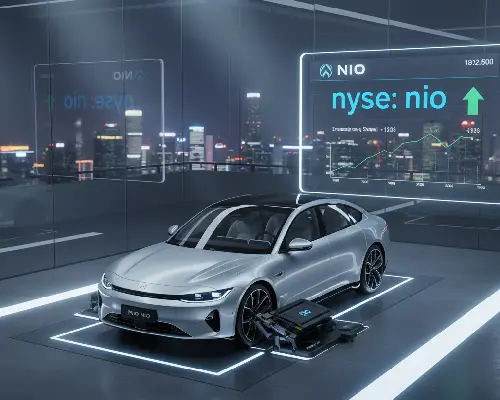
NIO stands out for two practical reasons: its focus on a battery-swapping network and its bundled services (subscriptions, in-car software, concierge). Battery swap stations let drivers trade a depleted battery for a charged one in minutes — a differentiator in markets where fast charging infrastructure is inconsistent.
The business model explained
Vehicle sales and margins
Like other automakers, NIO makes most revenue from selling vehicles. Gross margins on cars can be thin initially, especially with new models and high R&D, but scale + parts localization usually improve margins over time. For NIO, margin progress depends on production efficiency, supply chains, and model mix.
Subscription services & battery-as-a-service (BaaS)
NIO separates battery ownership from the vehicle through BaaS (Battery-as-a-Service). Customers buy the car but subscribe to battery capacity and swap services. This lowers upfront cost for buyers and creates recurring revenue for NIO — a powerful model if subscribers stay long-term.
Energy and charging ecosystem
NIO’s business also includes charging stations, home chargers, and energy services. The ecosystem approach tries to lock in customers by offering convenience and predictable ownership costs, which can translate into higher lifetime value per customer.
Technology & product lineup
Flagship models (ET, ES, etc.)
NIO’s portfolio includes SUVs and sedans with names like ES and ET series (among others). The company updates models regularly and introduces new variants, keeping product momentum alive.
Software, autonomy, and in-car AI (Nomi)
NIO invests heavily in software: driver-assist systems, OTA (over-the-air) updates, and an in-car AI assistant named Nomi. Software enables a premium experience and recurring monetization (paid features).
New initiatives (phones, sub-brands)
Beyond cars, NIO has explored adjacent products, like a branded smartphone and sub-brands aimed at lower-price buyers. These initiatives diversify revenue and may feed more integrated services into the vehicle experience.
Financial basics for investors
Revenue streams and profitability path
NIO generates revenue mainly from vehicle sales, subscriptions (BaaS), and energy/charging services. Profitability is achieved through higher delivery volume, higher ASPs (average selling price) on premium models, cost cuts, and rising service revenue. Analysts often watch delivery growth and gross margin trends as the clearest indicators of progress.
Key numbers to watch (deliveries, margin, cash)
- Vehicle deliveries (monthly/quarterly) — growth or slowdown.
- Gross margin — product profitability.
- Operating cash flow & cash reserves — how long NIO can invest before turning net-cash-positive.
Tracking those three gives you the basic health picture.
How to read NIO’s earnings headlines
Earnings season for nyse: nio will focus on deliveries, guidance, margin improvements, and cash burn. A single quarter of weaker-than-expected deliveries often causes sharp stock swings, so watch the headlines — and the management commentary — carefully.
Stock specifics: _nyse: nio_
How the ADR listing works (NYSE)
NIO trades on the NYSE as an ADR, meaning shares listed are backed by shares issued overseas. ADRs make it easier for U.S. investors to buy foreign stocks without dealing with foreign exchanges directly.
Volatility and liquidity (what to expect)
Expect higher-than-average volatility. Growth EV names move dramatically on news: deliveries, regulatory updates, analyst notes, or macro shifts. Liquidity is usually strong, but price gaps and big moves around earnings are common.
Where to find reliable quotes
Use major finance sites (broker quotes, Yahoo Finance, MarketWatch, company IR page) for up-to-date pricing and official filings. For U.S. investors, the NYSE listing page and NIO’s investor relations site are authoritative sources.
Risks every reader should know
Competition and pricing pressure
The EV landscape is crowded: Tesla, BYD, Xpeng, Li Auto, and legacy automakers are all fighting for market share. Price competition, subsidies, and new models can quickly squeeze margins.
China and regulatory/geopolitical exposure
NIO’s core market is China — which means regulatory and geopolitical factors (e.g., trade friction, data rules) can affect operations and investor sentiment. Cross-border legal or investor disputes can also trigger big swings. Recent legal news involving major investors and allegations has shown how headlines can hit the stock hard.
Execution risk and capital needs
Scaling auto production is capital-intensive. If delivery growth slows or cash runs tight, the company may need new funding, which can dilute shareholders or hurt sentiment.
Catalysts that could move the stock
Delivery beats / misses
If NIO reports deliveries that beat expectations, the stock often rallies — misses usually trigger steep declines. Delivery growth is the clearest indicator demand is strong.
Profitability milestones & margin expansion
Announcements of sustained quarterly profits, better-than-expected gross margins, or positive free cash flow are major stock catalysts. Management targets for profitability are watched closely.
International expansion and partnerships
Moves into new countries, partnerships with battery suppliers, or infrastructure deals (e.g., battery swap partnerships) can expand addressable markets and influence valuations. Strategic partnerships with battery makers or local governments are especially important in scaling operations.
Simple ways to analyze the company (tools & ratios)
EV/Revenue, gross margin, free cash flow
For high-growth companies like NIO, EV/Revenue can be more relevant than P/E (which may be negative). Watch gross margin trends and free cash flow — improving numbers here often precede sustainable valuation increases.
Delivery trend charts and guidance vs. actual
Plot deliveries quarter-over-quarter and compare company guidance vs. actual results. Consistent upward trends are a positive signal; large swings or missed guidance require deeper digging.
How a long-term investor might think about _nyse: nio_
Growth vs. value lens
Long-term investors treat nyse: nio as a growth bet on EV adoption, services, and potentially international expansion. If you believe EV adoption in China and Europe will accelerate and that NIO’s services will secure recurring revenue, you might allocate a portion of a growth-focused portfolio to the stock — sized according to risk tolerance.
Dollar-cost averaging and position sizing
Given volatility, many long-term investors use dollar-cost averaging (DCA) to build a position over time and avoid trying to time peaks/troughs. Also limit any single position to a percentage you can tolerate losing in a downturn.
How a short-term trader might approach _nyse: nio_
News catalysts and earnings plays
Short-term traders watch news flow: delivery updates, partnerships, regulatory headlines, and analyst notes. Earnings nights are high-risk, high-reward plays; options strategies like straddles or protective puts are common.
Technical levels and volatility management
Traders use support/resistance, moving averages, and volume spikes to guide entries/exits. Stop-losses and size limits help manage the big swings typical for nyse: nio.
Common myths and misunderstandings
“NIO is just another Tesla copy”
NIO builds premium EVs, but its business leans heavily into services (battery swapping, subscription models) and community-driven retail (Nio Houses). Those differences matter operationally and strategically — it’s not a pure Tesla clone.
“Battery swap is niche”
Some say battery swap won’t scale; others see it as a practical solution for fast turnaround in dense markets. The real answer: it depends on execution, partnerships, and customer economics. If swap networks expand and customers adopt BaaS, it becomes a competitive advantage.
A quick checklist before you buy _nyse: nio_
Financial checklist
- Are deliveries growing sequentially and yearly?
- Is gross margin improving?
- Is the cash runway comfortable or shrinking fast?
Operational checklist
- Any production bottlenecks?
- Battery supply and swap network growth?
- International expansion progress?
Personal finance checklist
- Can you afford the volatility?
- Is this a speculative allocation or core holding?
- Do you have a clear exit or re-evaluation plan?
Final thoughts and wrapping up
If you’re curious about nyse: nio, remember this: it’s a story stock — growth-driven, weather-prone, and highly sensitive to news and execution. The company’s strengths lie in unique customer services (like battery swapping) and a premium product line, while risks include fierce competition, capital needs, and geopolitical headwinds. For any investor, clarity about time horizon, risk tolerance, and how NIO fits into your portfolio is the most valuable first step.
Key, up-to-date facts to anchor your view: NIO is a 2014-founded Shanghai-based EV maker that trades as NYSE: NIO; it emphasizes battery-swap services and software-driven features; and its market value and news headlines can move quickly based on deliveries, partnerships, and legal/regulatory developments.
Frequently Asked Questions
What exactly does the ticker _nyse: nio_ mean?
nyse: nio simply denotes that the NIO American Depositary Receipts (ADRs) trade on the New York Stock Exchange under the symbol NIO. ADRs let U.S. investors buy shares in foreign companies more easily.
Is NIO profitable yet?
Profitability has been a work-in-progress. The path to profit depends on delivery growth, margin improvement, and cost control. Look at the latest quarterly results and management guidance for the current status — profitability can change quarter-to-quarter.
Why is battery swapping important for NIO?
Battery swapping reduces “refuel” time, lowers upfront vehicle cost via BaaS, and creates recurring revenue. If widely adopted, it could be a meaningful competitive edge, especially in densely populated regions where fast turnaround matters.
How risky is investing in _nyse: nio_ compared to other EV stocks?
Risk is high across most EV names, including nyse: nio. Specific risks include execution, capital needs, geopolitical exposure, and competition. That said, NIO’s unique services and brand presence offer upside if execution holds.
Where can I find credible, up-to-date information about NIO?
Start with NIO’s investor relations page, major finance portals (Yahoo Finance, MarketWatch), and reputable news outlets for developments. Official filings and quarterly reports are the best sources for verified financials.